
Civic Engagement for Climate Change Education: reflections from the conference

Michelle Graffagnino, senior lecturer in the School of Education, on the Civic Engagement for Climate Change Education (CCE) conference and the transformative role of CCE education.

Working with children, teachers and researchers across Bristol I have felt an increasing urge to support school colleagues in achieving the vision and aims of the Department for Education’s (DfE) Sustainability and Climate Change Strategy. See Leaky spaces for CCE are not enough. The DfE strategy was launched in 2022 and by 2025 every education setting must have a Climate Action Plan and sustainability leader.
(more…)

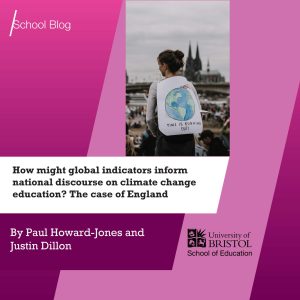
How might global indicators inform national discourse on climate change education? The case of England

By Paul Howard-Jones and Justin Dillon

On April 21st 2022, the UK government published its first education strategy for England on sustainability and climate change. It envisions that, by 2030, “the United Kingdom is the world-leading education sector in sustainability and climate change”.

Many might consider the threat of climate change alone as sufficient grounds for prompting a sense of urgency in educational policy making. However, global competitiveness and national prestige are potent political motivators that often feature in government discourse and policy, and it appears as true for climate change education as it does for other areas.

It could be claimed that the UK kickstarted global industrialisation in the 1700s, along with all its many opportunities and challenges, including the warming of our planet. It might be appropriate, therefore, that the UK wishes to lead education development in this area and such ambition should be applauded. In many respects, it’s exciting and reassuring to think of a world in which nations compete in a virtuous race to improve climate change communication and education (CCE).