Unveiling the feedback secret: Your bridge to academic success

Greetings!

I’m Lala Ismayilova from Azerbaijan and I had the privilege of being an international Master’s student at the University of Bristol in the academic year 2022/2023 to study Education Leadership and Policy (MSc.). This enabled me to fully comprehend the blend of excitement that accompanies studying in a foreign land.

In this blog post, I aim to shed light on the transformative influence of formative feedback, emphasizing how it can serve as a vital conduit to achieving academic excellence during your tenure at this esteemed institution. (more…)

Most secondary schools don’t have to teach the national curriculum. It should be revised and restored – or discarded

This article is republished from The Conversation under a Creative Commons license. Read the original article.

Lorna Smith, University of Bristol

Each year, when new PGCE students arrive at the University of Bristol to start their journey towards becoming English teachers, I ask them to study the national curriculum. This is the statutory document prescribing what children aged from five to 16 are taught at school.

I do this despite that curriculum appearing increasingly irrelevant. It is rarely – if ever – seen in the schools in which our student teachers train, despite it being the only document mandating what council-maintained schools “must teach”.

Academies – self-governing schools receiving direct government funding, rather than being council-maintained – are exempt from the curriculum. As of January 2023, 80.4% of secondary schools are academies or free schools, accounting for 80.2% of secondary school pupils.

The importance of the curriculum will change if a Labour government comes to power at the next general election. The party has promised a review of curriculum and assessment – and that all state schools, including academies, will be required to follow the “core national curriculum”.

It may be, though, that the national curriculum has outlived its usefulness. A more radical approach could be to dispense with it altogether. (more…)

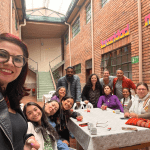
BlogJAM: Latin America regional encuentro – Four days of mutual learning and good vibes

Blog by Dr Raúl Valdivia-Murgueytio, EdJAM Research Associate, University of BristolEdJAM-Regional-Event_July-23_Picture

The EdJAM regional event in Bogota, Colombia, was a resounding success. During the last week of July, colleagues from all the EdJAM-funded projects in Latin America came together to share their approaches to dealing with the violent past in their communities. This was also an opportunity to get to know each other in person after a year of online meetings, and to discuss future collaborations. (more…)